 blog
What Are the Best Interactive Cat Toys for Solo Play?
Last Updated: October 30, 2026
Quick Summary
The best interactive cat toys for solo play are motion-activated electronic toys, ball-and-track circuits, spring toys, toy mice, and puzzle feeders, because a cat can trigger and chase them alone. Choose toys with no strings or detachable parts, and rotate them weekly to keep engagement high.
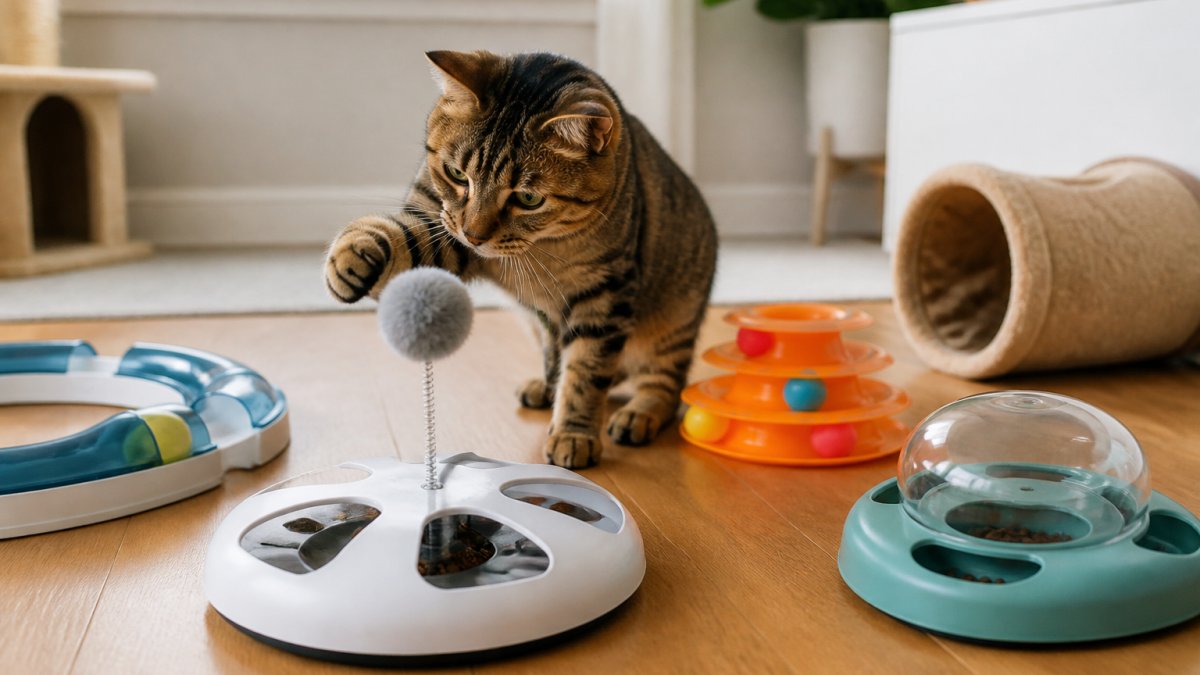
- Motion-activated toys sit idle until a cat walks past, then twitch, roll, or pop out.
- Ball-and-track circuits keep the ball in a channel so it cannot disappear under the sofa.
- Feather wands are the worst choice for solo play because cats chew and swallow the string.
- Keep a stash of 8 to 12 toys and put out 3 or 4 at a time.
- Most electronic toys run on a timer cycle and stop after ten or fifteen minutes.
Table of Contents
- Why Solo Play Toys Matter for Indoor Cats Home Alone
- The Best Cat Toys for Independent Play by Category
- How to Choose Safe Cat Toys for Unsupervised Play
- Automatic Cat Toys: What They Can and Cannot Do
- Matching Toys to Your Cat's Age, Temperament, and Play Style
- How to Keep a Cat Entertained Alone Without Constant Toys
- Rotating Toys to Prevent Boredom and Keep Engagement High
- Planning Solo Enrichment Before Your Next Trip
- Frequently Asked Questions
Why Solo Play Toys Matter for Indoor Cats Home Alone
Indoor cats left alone for long stretches need a way to act on their hunting instinct without a human holding the wand.
Solo play is not the same as keeping a cat busy. It is structured enrichment that lets a cat perform natural behaviors: stalking, pouncing, batting, carrying prey, and problem-solving for food.
The catch is that no toy replaces a person. Automatic toys buy you time between visits; they do not replace interaction.
The Best Cat Toys for Independent Play by Category
Toy categories behave differently when nobody is in the room. Some run on their own for a few minutes and stop. Others sit still until a cat touches them. Others are food puzzles that work only as long as the cat cares about the reward. Here is how the main categories compare.
| Toy Type | How It Engages | Runs Without a Person | Best For | Main Drawback |
|---|---|---|---|---|
| Motion-activated electronic toys | Sensor triggers movement when the cat approaches | Yes, for a set cycle | Active cats, short bursts | Battery drain, noise |
| Ball-and-track circuits | Cat bats a ball around a fixed track | Yes, indefinitely | Kittens and young adults | Ball jams, gets ignored |
| Spring toys and pom-pom balls | Lightweight, unpredictable bounce | Yes, when batted | Cats that love to carry prey | Ends up under furniture |
| Toy mice | Prey-like shape and size | Only when thrown or swatted | Cats with strong stalk-and-pounce drive | Small parts, stuffing |
| Puzzle feeders and treat dispensers | Food reward for pawing or nosing | Yes, until the food runs out | Food-motivated cats, mental stimulation | Some cats solve it too fast |
| Feather wands | Mimics bird flight | No, needs a person | Bonding sessions | String is a hazard unsupervised |
Motion-Activated and Electronic Toys
Motion-activated toys sit idle until a cat walks past, then twitch, roll, or pop out of a hiding spot.
Two details decide whether an electronic toy earns its place: battery life, because a toy that dies in a week gets abandoned, and noise level, since a loud motor can startle a shy cat.
Most electronic toys run on a timer cycle and stop after ten or fifteen minutes. That is fine. Short bursts of real engagement beat a toy that runs all day and becomes background noise.
Ball-and-Track Circuits and Spring Toys
Spring toys and pom-pom balls are cheap, bounce erratically, and cats love to carry them. The trade-off is that they end up under appliances within a day. Buy them in multiples and accept the loss rate.
Interactive balls with a bell or crinkle inside add sound to the movement, which helps cats track the toy in low light. Skip anything with a bell that comes loose.
Toy Mice, Feather Wands, and Puzzle Feeders
Toy mice appeal to the stalk-and-pounce sequence. Realistic size and a soft body matter more than gimmicks. Check the eyes and tail attachments on anything left out unsupervised.
Feather wands are the best interactive cat toys for bonding, and the worst choice for solo play.
Puzzle feeders and treat-dispensing toys convert food into an activity. A food-motivated cat will work a dispenser for a long stretch, and the mental stimulation lasts longer than the food.
How to Choose Safe Cat Toys for Unsupervised Play
Safety comes first, because a toy left alone with a cat gets chewed, swallowed, and pulled apart in ways it never would during supervised play. Ask what happens when the toy fails.
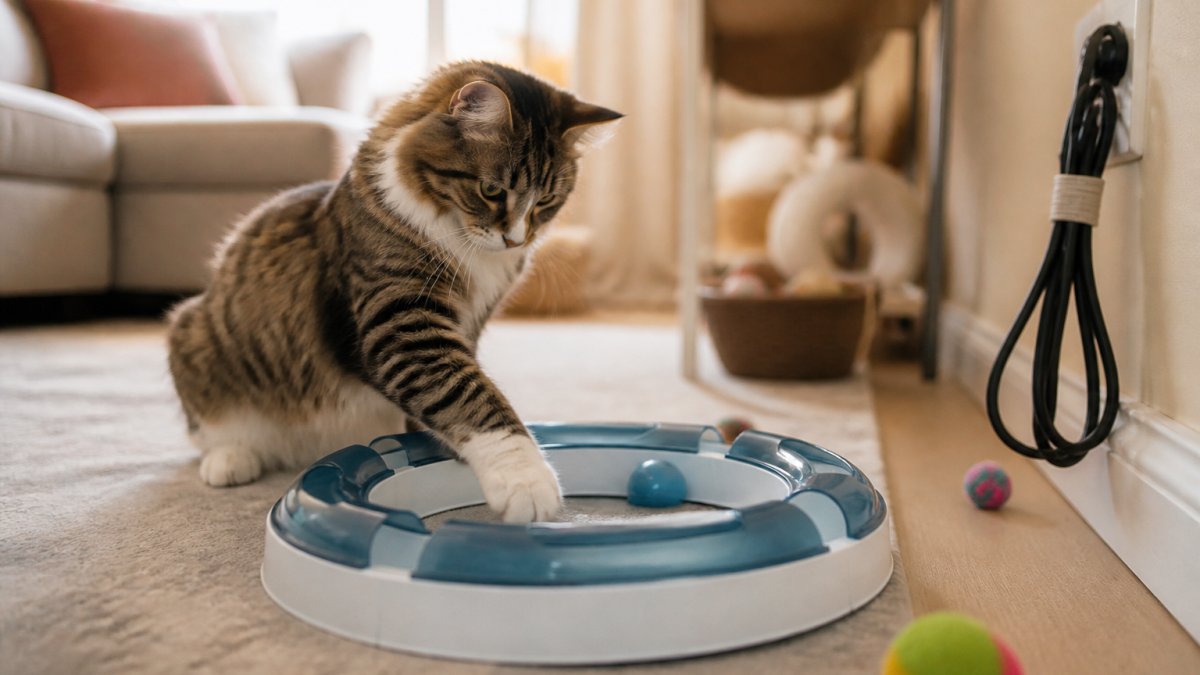
Run through this checklist before any toy goes into the solo-play rotation:
- No strings, ribbons, or elastic longer than a few inches
- No small parts that can detach: bells, eyes, pompoms, squeakers
- No loose stuffing or exposed foam
The ASPCA's guidance on hazardous items for pets is a reasonable reference point for what to keep out of reach. When in doubt, choose the simpler toy.
Automatic Cat Toys: What They Can and Cannot Do
Automatic cat toys are useful for covering the gaps between human play sessions.
What they do well is trigger hunting behavior on demand. A motion-activated toy that fires when a cat walks past gives a bored cat a reason to move.
Treat automatic toys as a supplement, not a substitute for the interaction a cat gets from a person or a sitter.
Matching Toys to Your Cat's Age, Temperament, and Play Style
The same toy that delights a four-month-old kitten can sit untouched in front of a senior cat, and the difference is capability, not preference. Use this section to buy for the cat in front of you.
Match the toy to the cat, not the other way around
Use this as a starting filter. A toy that clears the safety checklist but fails this match will still get ignored, and an ignored toy is money on the floor.
| Cat profile | What works | What to skip | Why |
|---|---|---|---|
| Kittens (under about 6 months) | Ball-and-track circuits, lightweight spring toys, soft toy mice, low-difficulty puzzle feeders | Heavy electronic toys, tight puzzle feeders, anything with string | Kittens are still learning coordination and bite pressure; light, forgiving toys reward clumsy pounces without injury |
| High-energy young adults | Motion-activated electronic toys, circuits, treat-dispensing balls, flirt-style toys used supervised | Static toys with no movement | This cat needs output, not just novelty; movement and food reward burn energy |
| Cautious or shy cats | Toys the cat can approach on its own terms: a circuit in a quiet corner, a puzzle feeder near a hiding spot, a toy mouse left still | Loud motorized toys, toys that fire suddenly in the cat's face | A startle response can permanently poison a toy; let the cat initiate |
| Seniors (roughly 10+ years) | Soft, low-effort toys, food puzzles placed at floor level, crinkle balls batted from a resting position | High-jump toys, fast erratic motion, anything requiring a chase across the room | Jumping and sharp turns get harder with age; keep the reward close and the effort low |
| Food-motivated cats | Puzzle feeders, treat-dispensing balls, snuffle-style mats | Toys with no reward | Food is the strongest motivator; a cat that ignores toys will work for kibble |
| Cats who ignore treats | Motion toys, circuits, spring toys, toy mice | Puzzle feeders as the primary toy | If food does not motivate, movement has to do the work |
| Strong stalk-and-pounce drive | Toy mice, feather toys used supervised, motion-activated prey toys | Ball-only toys with no prey shape | The shape and size of prey matter to this cat; a plain ball does not complete the sequence |
| Cats who love to carry | Soft toy mice, lightweight pom-poms, crinkle balls | Fixed circuits, heavy electronic toys | Carrying is the reward; the toy has to be light and grabbable |
Read the cat's play style before you buy
A cat's play style is a better predictor than breed or age. Watch one supervised session and note which part of the sequence the cat repeats. A cat that stalks and freezes wants prey-shaped toys and motion it can track.
A common mistake is buying for the cat you wish you had. If your cat hides from new things, our guide to interactive toys for shy cats covers a gentler introduction approach.
How to Keep a Cat Entertained Alone Without Constant Toys
Toys are only one part of keeping an indoor cat engaged while you are gone, and owners who rely on toys alone usually end up with a bored cat anyway.
Cats are crepuscular, most active around dawn and dusk, so a play session before you leave and another when you get home lands when the cat is ready to engage.
If you work full time, some cats need more company than a toy can provide. Our guide on socializing a cat while working full time covers how to build that into a schedule.
Rotating Toys to Prevent Boredom and Keep Engagement High
Novelty is the cheapest enrichment tool you own. A toy that has been on the floor for two weeks is furniture; the same toy pulled out of a closet after a week away is new again. Rotation works because cats respond to novelty, not to the toy's price.
Why rotation works
A cat's hunting drive is triggered by movement and unpredictability, not by the object itself. Once a toy becomes predictable, the cat has learned everything it can from it and the toy stops triggering the sequence. Removing it for a week resets that learning. This is also why a floor covered in toys flattens the effect: constant access makes every toy predictable at once.
A simple weekly rotation plan
- Keep a stash of 8 to 12 toys in a closed bin or closet, out of the cat's sight and reach.
- Put out 3 or 4 at a time. Mix one motion or electronic toy, one bat-and-chase toy (circuit or spring), and one prey or food toy.
- Swap once a week. Pull the current set, put it away, and set out a different mix. Keep the same weekly day so it becomes routine.
How to introduce a toy the cat has never seen
Do not drop a new toy into the middle of the room and walk away. Introduce it the way you would introduce a new object to a cautious cat:
- Let the cat investigate while you are present. Put the toy on the floor a few feet away and sit still. Let the cat approach, sniff, and bat at its own pace.
- Trigger it once, then stop. For a motion toy, trigger a single cycle and let it stop. For a circuit, roll the ball once. Show the cat what the toy does; do not entertain it.
- Pair it with food or play if the cat is hesitant. A treat near the toy or a short wand session nearby can build a positive association.
- Leave it out for a day, then reassess. If the cat engages on its own, it joins the rotation. If not, put it away and try again in a few weeks.
What rotation does not fix
Rotation manages novelty, not capability. A senior cat who cannot chase will not engage with a fast toy no matter how new it is, and a food-motivated cat will ignore a motion toy that offers no reward. Use the age and temperament matching above to pick the right toys first, then use rotation to keep them interesting. If a cat ignores every toy in the rotation, the problem is usually the match, not the schedule.
Planning Solo Enrichment Before Your Next Trip
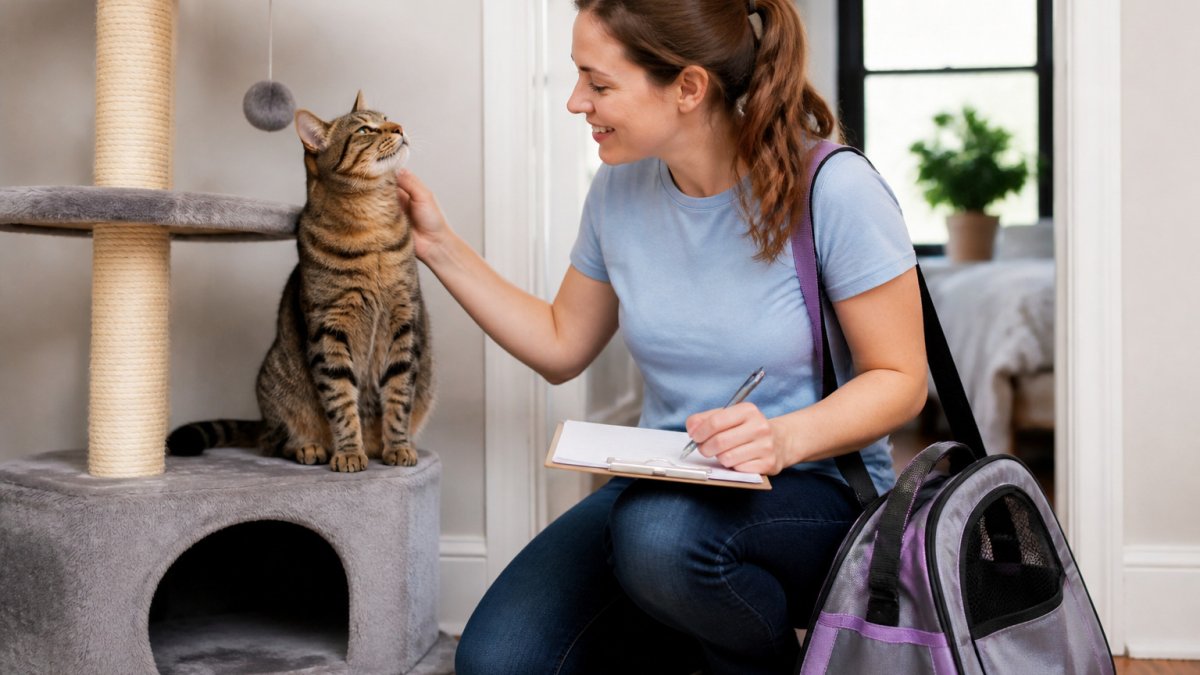
Travel prep is where solo enrichment stops being optional. A cat alone for a day manages fine with toys and a window. A cat alone for a week needs a plan, and the toys are the smallest part of it. Our checklist for preparing your cat for a sitter walks you through getting your cat and home ready.
A sitter fills the gap toys cannot. A sitter can provide a cat with interaction and a person who notices when something is off. Daily drop-in visits for indoor cats give your cat that interaction beyond toys while you are away. Our cat sitting service is built around that. If you are still deciding how to cover a trip, our guide on keeping indoor cats entertained while away for work goes deeper.
Frequently Asked Questions
What are the best interactive cat toys for solo play?
The best interactive cat toys for solo play combine motion, texture, and low supervision risk. Ball-and-track circuits, motion-activated electronic toys, spring toys, and puzzle feeders top most lists because they trigger hunting instinct without needing a person to move them. Rotate three to five options at a time so novelty stays high. Skip anything with loose strings, small detachable parts, or batteries a cat can reach, since those create choking and safety risks when you are not home.
Are automatic cat toys safe to leave on while I'm away?
Some automatic cat toys are safe for unsupervised play, but not all. Choose battery-operated or rechargeable toys with enclosed compartments, no exposed cords, and no small parts that can pop off. Test each toy during supervised play first to see how your cat interacts with it. Avoid toys with string, ribbon, or feathers on long wands left dangling, since these are common choking and entanglement hazards. Check batteries and moving parts regularly, and remove any toy that shows cracks or loose pieces.
How long should a cat play with an interactive toy?
Most cats do well with two to three short play sessions of 10 to 15 minutes each day, plus access to solo toys in between. Solo toys like puzzle feeders and ball tracks can stay out longer, but rotate them every few days to prevent boredom. Watch for signs your cat is losing interest, such as walking away or ignoring the toy, and swap in something new. Senior cats and kittens often need shorter, gentler sessions.
Do cats get bored of automatic toys?
Yes, cats often lose interest in automatic cat toys after a few days if the toy is always available. The fix is toy rotation: keep three to five toys in circulation and store the rest out of sight, swapping them weekly. Pair automatic toys with puzzle feeders and climbing structures so your cat has variety. Even the best interactive cat toys for solo play work better as part of a rotation than as a single permanent fixture.
Leaving a cat alone with a pile of toys is not the same as leaving it cared for. The toys help, and the interaction is what a cat actually needs. Tracy's Kitty Care sends background-checked, licensed, bonded, and insured sitters into your home so your cat stays in its own environment with real company, real play, and someone watching for problems. Get started with Tracy's Kitty Care and give your cat consistent care while you are away.