 blog
What Flooring Holds Up Best to Cat Claws?
Last Updated: October 28, 2026
Quick Summary
Luxury vinyl plank and vinyl sheet are the most durable flooring for cat owners, because a thick wear layer resists claws, textured finishes hide scratches, and tight seams keep urine out. Vinyl sheet has the edge on seams since it has far fewer of them. Laminate resists scratches but its core swells if water reaches a seam.
- Durability for cat owners means a thick wear layer, a scratch-hiding finish, and tightly sealed seams working together.
- Matte and textured finishes scatter light so fine claw marks disappear, while high-gloss finishes show every scuff.
- Seal seams per the manufacturer's instructions and use a waterproof underlayment rated for the product.
- A waterproof mat with a waterproof backing under every litter box and water bowl is cheaper than any subfloor repair.
- Buy spare boxes at installation because a replacement plank from a different production run may not match.
Table of Contents
- What Makes Flooring Durable Enough for Cats?
- Scratch-Resistant Flooring for Pets: How Each Material Performs
- Waterproof Flooring and Urine Seepage: Protecting the Subfloor
- How to Clean Cat Urine From Hardwood Floors
- Pet-Friendly Flooring Pros and Cons by Material
- Litter Tracking, Traction, and Comfort for Older Cats
- Matching a Flooring Choice to Your Cat and Your Budget
- Frequently Asked Questions
What Makes Flooring Durable Enough for Cats?
Cat claws are small chisels, and cat urine is a stubborn liquid. Durable flooring options for cat owners have to survive both, which is why most buying guides miss the point.
Durability for cat owners means three things working together: a wear layer thick enough to resist claw marks, a surface finish that hides scratches, and seams sealed tightly enough to keep liquid out. A floor that scores well on only one of those is a floor you will be replacing early.
Wear Layer, Finish, and Seams: The Three Specs That Decide It
The wear layer is the clear top coating on vinyl and laminate that takes the abuse.
The surface finish decides how visible damage becomes. Matte and textured finishes scatter light, so fine claw marks disappear.
Seams are where urine wins.
The Resilient Floor Covering Institute's guidance on resilient flooring performance is a useful primer on how wear layers and finishes are rated before you compare products.
Scratch-Resistant Flooring for Pets: How Each Material Performs
Scratch-resistant flooring for pets comes down to hardness and finish.
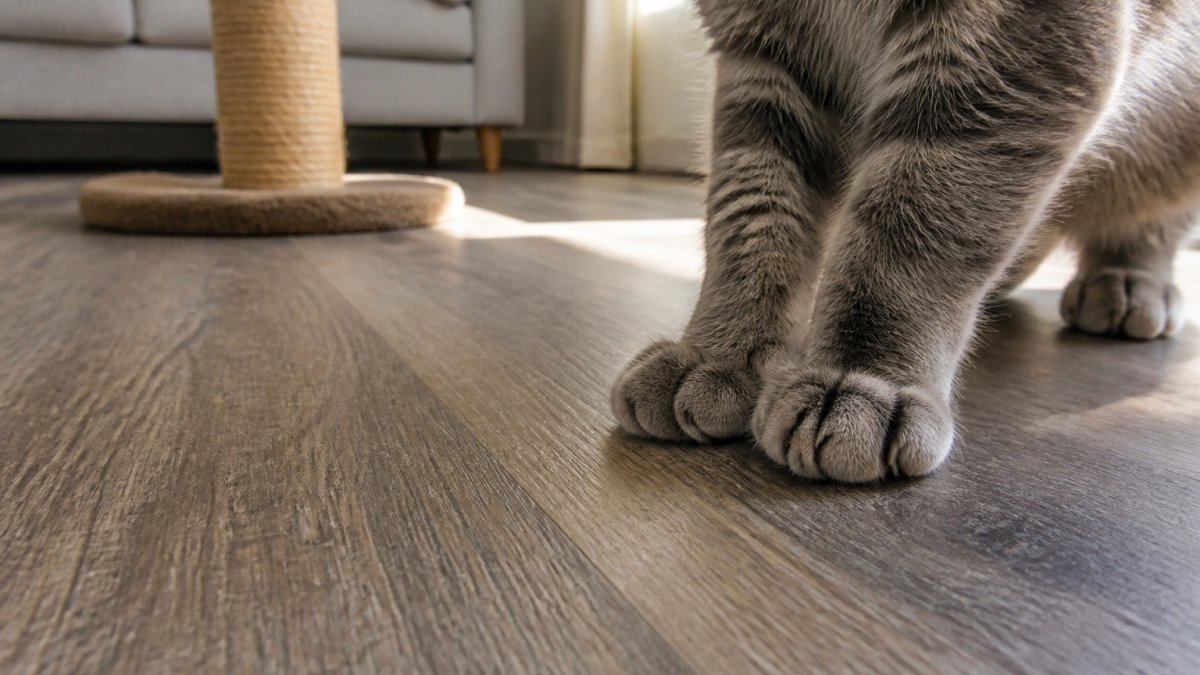
Luxury vinyl plank and vinyl sheet sit at the top for most cat households.
Laminate offers strong scratch resistance on its surface, but the core swells if water reaches it through a seam.
Ceramic tile laughs at claws and water.
A common mistake is judging a floor by its photo. For practical tips on preventing carpet snags from cat claws, see our dedicated guide.
Waterproof Flooring and Urine Seepage: Protecting the Subfloor
Waterproof flooring only protects the subfloor when the water cannot get past the edges. That is the part most shoppers never ask about, and it is where real damage starts. A plank can be rated waterproof and still let a puddle reach the plywood underneath, because the rating describes the plank, not the floor as an assembled system.
Urine accidents on a plank floor wick sideways through seams and down at the perimeter. Once liquid reaches the subfloor, odor control becomes a demolition project. Three details prevent it:
- Seal seams per the manufacturer's instructions, and use a waterproof underlayment rated for the product
- Caulk or seal at the wall edge, and finish with trim that keeps liquid from running under the baseboard
- Pull the litter box off bare flooring onto a mat with a waterproof backing
Watch out: skipping perimeter sealing because "the planks are waterproof" is the single most expensive shortcut in a cat household. The planks survive. The subfloor underneath does not.
Where Urine Actually Gets In
Think of a floating plank floor as a roof made of overlapping shingles. The plank faces shed liquid fine. The failure points are the joints between planks, the expansion gap at the wall, the transition strips at doorways, and any penetration for a floor vent or radiator pipe.
Sheet vinyl has a structural advantage here: with far fewer seams, there are far fewer entry points. A glued-down sheet with heat-welded seams is about as close to a continuous surface as resilient flooring gets.
Subfloor, Underlayment, and What Sits Below
What is under the wear layer decides how a spill behaves. A waterproof rigid-core plank with an attached pad keeps liquid on top longer than a laminate core that swells on contact. But no underlayment rescues a floor whose perimeter is open. If you are installing over a wood subfloor, a moisture-barrier underlayment rated for the product adds a second line of defense; over a concrete slab, the slab itself is unforgiving because it wicks and holds odor.
Seams, Transitions, and Trim: The Installation Checklist
Ask your installer to confirm, in writing, four things: seams sealed per the manufacturer's method, a continuous bead of sealant at the wall edge under the trim, transition strips bedded in sealant at every doorway, and any floor penetrations sealed. Then check the caulking line at the baseboards twice a year and refresh it where it has cracked. These are small line items that decide whether an accident is a wipe-up or a rip-out.
When Urine Has Already Reached the Subfloor
Surface cleaning will not fix odor that has soaked into the subfloor. Enzymatic cleaners work on the surface residue; once the liquid is below the plank, the fix is extraction, sealing the affected subfloor with a stain-and-odor-blocking primer, and in severe cases replacing the damaged section. Catching it early is the whole game, which is why a sitter who notices a soaked seam on day one saves you a subfloor job.
How to Clean Cat Urine From Hardwood Floors
Cleaning cat urine from hardwood floors starts with speed, not strength. Blot up as much as possible within minutes, then treat the spot with an enzymatic cleaner made for pet messes, following the label exactly.
Avoid soaking the wood. Standing water and excess cleaner work into seams and finish edges, causing the swelling and staining you were trying to prevent.
If urine has already reached the subfloor, surface cleaning will not fix the smell. That is a job for a deeper extraction, and our guide to deep cleaning pet stained carpet walks through the same layered approach for porous surfaces.
Pet-Friendly Flooring Pros and Cons by Material
Pet-friendly flooring pros and cons rarely line up neatly, because the best floor for claws is not always the best floor for joints or budgets.
| Material | Scratch Resistance | Water Resistance | Comfort and Traction | Repairability |
|---|---|---|---|---|
| Luxury vinyl plank | High | High | Moderate | Plank-by-plank |
| Vinyl sheet | High | Very high | Moderate | Patch only |
| Laminate | High | Low at seams | Moderate | Plank-by-plank |
| Ceramic tile | Very high | Very high | Low, cold and slick | Tile-by-tile |
| Hardwood | Low | Low | High | Sand and refinish |
| Bamboo | Low | Low | High | Sand and refinish |
The lifecycle math is where opinions should sharpen. Vinyl and laminate are cheaper to install and easy to repair in small sections, but they have a shorter service life.
The one drawback nobody mentions: repair matching. A replacement plank from a different production run may not match, so buy spare boxes at installation.
Litter Tracking, Traction, and Comfort for Older Cats
Litter tracking is a flooring problem as much as a litter problem, and it is the cat-specific issue most general pet-flooring guides skip. The fix is a system, not a single product: the litter itself, the mat at the box, the floor beyond the mat, and where the box sits relative to the rest of the house.
How Each Surface Handles Tracking
- Textured vinyl and laminate: the embossing that hides claw marks also grips litter grains. Good for scratch visibility, worse for tracking.
- Smooth sheet vinyl and polished tile: let a mat do the work; grains slide off rather than lodge.
- Grout lines: trap litter and dust and are the hardest part of a tile floor to keep clean around a litter box.
The Mat-and-Placement System
Place a textured mat at the litter box exit and a second one a few feet away, so most tracking stops there. Use a mat with a waterproof backing, and shake it out daily rather than vacuuming it weekly. Keep the box off bare flooring and away from walls where urine can run to the perimeter seam. A high-sided box reduces scatter; a box in a low-traffic corner reduces the distance tracked litter travels.
Traction and Slip Resistance
Traction matters more than most owners expect. Slick tile and glossy vinyl give an older cat nothing to push against, and slipping is how senior cats start avoiding rooms. Choose a finish with some tooth to it, keep nails trimmed, and put area rugs on the main paths a senior cat uses. A floor that is easy to clean but slippery is a poor trade for an arthritic cat.
Comfort and Surface Temperature
Comfort is the other half of the equation: cats sleep on floors for most of the day, and a hard surface is harder on old joints than a warm, slightly cushioned one. Tile and concrete feel cold; vinyl and laminate feel closer to room temperature; a cushioned underlayment or an area rug adds warmth and give. For a senior cat, the best floor is often the durable one plus rugs where the cat actually rests.
For textured carpet that already collects hair and litter, our step-by-step guide on removing pet hair from textured carpet covers the tools and sequence that actually work.
Matching a Flooring Choice to Your Cat and Your Budget
The right floor depends on your cat's habits and your household, not on a generic ranking. Use this decision guide:
- Young, high-energy cat that sprints and scratches: luxury vinyl plank with a thick wear layer and a matte finish
- Senior cat with joint stiffness: vinyl with a textured surface, plus area rugs on the main paths
- Cat with frequent urine accidents: vinyl sheet or sealed vinyl plank, with perimeter caulking done properly
- Rental or short-term home: floating vinyl plank, which installs over existing floors with minimal disruption
If you want to protect the floor while you are away, our cat sitting service is available.
Frequently Asked Questions
What is the most scratch-resistant flooring for cats?
Porcelain or ceramic tile holds up best because the glaze is harder than a cat's claw and there is no wear layer to gouge. Among softer options, luxury vinyl plank with a thick wear layer (20 mil or more) resists claw marks far better than laminate or engineered hardwood. Solid hardwood is the most vulnerable to visible scratches. Whatever you choose, keep trimmed claws and two or three scratching posts so the floor is not the preferred target.
Is luxury vinyl plank flooring good for cats?
Luxury vinyl plank is one of the strongest choices for cat owners. The surface is waterproof, so urine accidents stay on top instead of soaking into the subfloor, and a wear layer of 20 mil or more resists claw marks and dents from active pets. Cleaning is simple with mild soap and water. The trade-offs: seams need tight installation and caulking at edges, and very heavy scratching can still dull the finish over time.
Does hardwood flooring hold up to cat claws?
Solid hardwood shows claw marks and dents more than most hard-surface flooring, especially with soft species like pine or fir. Harder species such as oak or hickory resist better, and a factory-applied aluminum oxide finish helps. The bigger risk is moisture: urine that reaches seams can stain and warp the wood. Hardwood can be sanded and refinished, which extends its life, but plan on more maintenance than vinyl or tile.
How do I protect my floors from cat urine and accidents?
Seal the weak points first: caulk along baseboards and trim, and check that plank seams are tight. Place litter boxes on trays or waterproof mats, and keep them away from walls and floor vents. Wipe accidents up promptly with an enzyme cleaner rather than ammonia-based products, which can attract cats back to the spot. If you are renting or cannot replace flooring, waterproof mats under boxes and in favorite spots are the lowest-cost protection.
Choosing a floor is the easy part. Keeping it intact through scratching, tracking, and the occasional accident takes daily attention, and that attention is exactly what slips when you travel. Tracy's Kitty Care provides in-home cat sitting with background-checked, licensed, bonded, and insured sitters who scoop litter boxes, watch for accidents, and keep your cat's routine steady while you are away. Get started with Tracy's Kitty Care and come home to a cat who barely noticed you left.