 how-to
How to Create a Stress-Free Environment for Cats
Table of Contents
- Signs of Stress in Cats: What to Watch For
- Build Vertical Territory and Safe Zones
- Cat Enrichment Ideas That Reduce Anxiety
- Use Feline Pheromone Diffusers and Scent Cues
- Establish Predictable Routines and Feeding Schedules
- Manage Multi-Cat Households and Resource Guarding
- Create a Stress-Free Environment During Life Transitions
- Frequently Asked Questions
Last Updated: September 13, 2026
Signs of Stress in Cats: What to Watch For
Learning how to create a stress-free environment for cats starts with reading the signals your cat already sends. At Tracy's Kitty Care, we walk into homes every week where owners say their cat is "fine," then watch that same cat flatten its ears, tuck its tail, and bolt under the bed. Cats hide distress well. That silence is exactly what makes stress so easy to miss.
Feline anxiety is a chronic stress response that shows up in behavior long before it shows up in illness. The American Association of Feline Practitioners' guidance on environmental needs groups those needs into five pillars, and stress almost always traces back to one of them being unmet.
Watch for these signs of stress in cats:
- Hiding more than usual, especially in new or rearranged spaces
- Over-grooming, bald patches, or pulling out fur
- Peeing outside the litter box, particularly on soft items
- Reduced appetite or eating only when you leave the room
- Excessive vocalizing, pacing, or tail flicking
- Sudden clinginess or the opposite: total withdrawal
A cat that hides when guests arrive is not being dramatic. It is managing a threat with the only tools it has.
The fix is not one change. It is a stack of small environmental adjustments that give your cat control over its own space. Here is what actually moves the needle.
Build Vertical Territory and Safe Zones
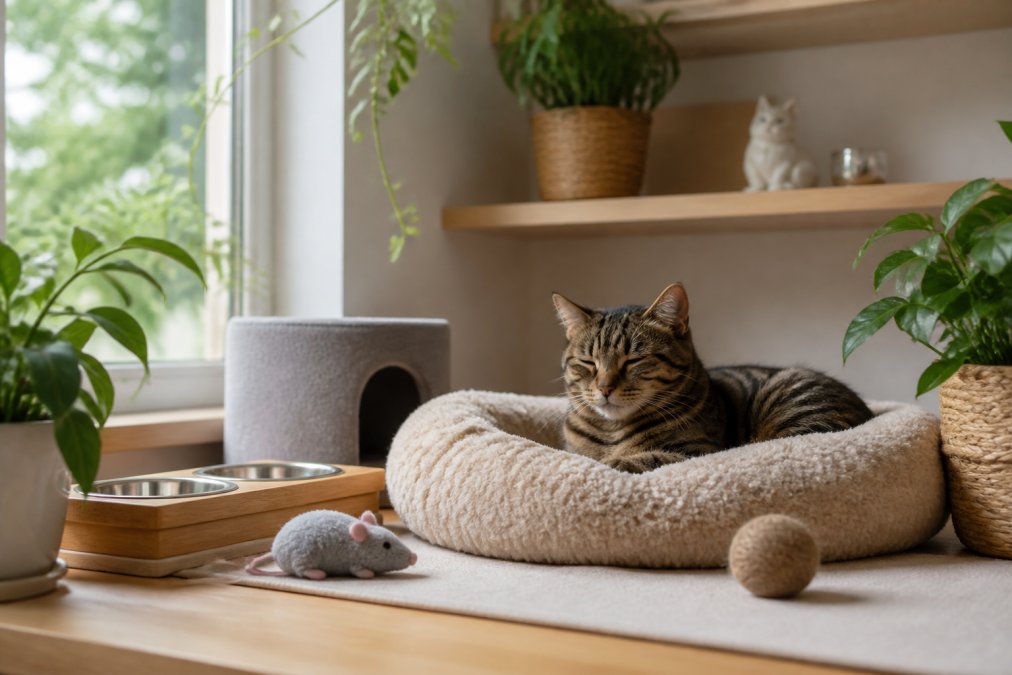
Vertical territory is the single fastest upgrade most homes can make. Cats are both predator and prey, so height equals safety. A cat that can survey a room from above relaxes in a way no amount of reassurance from you can replicate.
Start with these:
- A cat tree or shelving unit tall enough to see over furniture
- A window perch facing something interesting, like a bird feeder
- A safe haven in every room your cat uses, ideally with two exits
- Hiding spots that are dark, quiet, and not used for storage
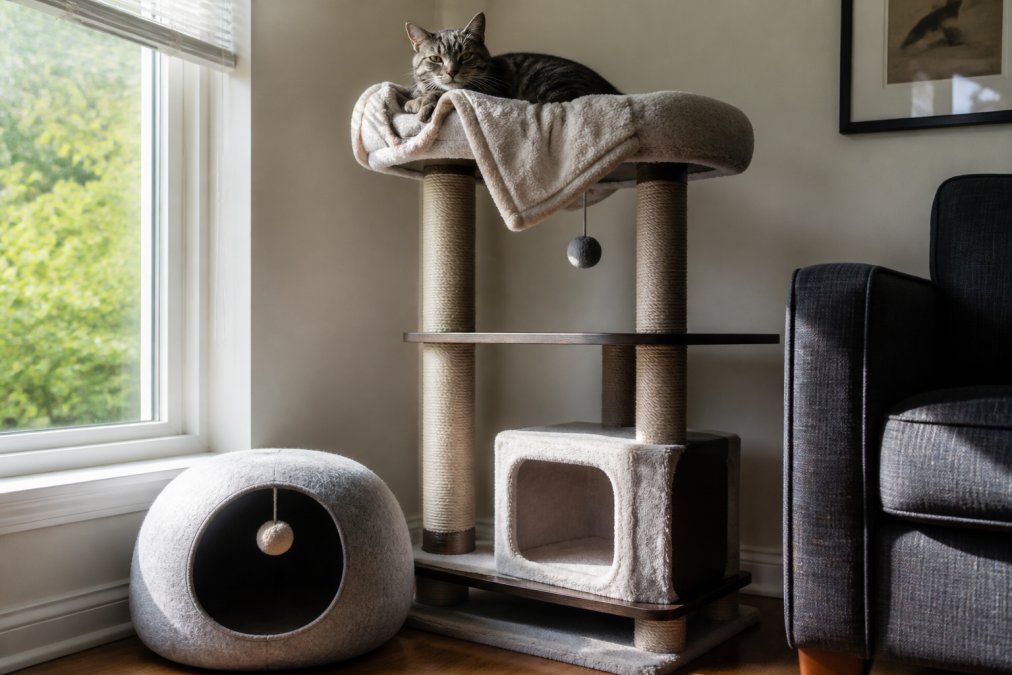
What most guides miss is placement. A cat tree shoved in a corner behind a couch does nothing. Put it where the action is but slightly above it, so your cat can watch without being approached.
Cat Enrichment Ideas That Reduce Anxiety
Environmental enrichment is not about buying more toys. It is about giving your cat something to do that mimics hunting: stalk, chase, catch, eat. When that sequence is missing, restless energy turns into anxiety.
Effective cat enrichment ideas:
- Food puzzles and puzzle feeders that make mealtime a hunt
- Wand toys used in short, intense sessions that end in a "catch"
- Scratching posts placed near resting areas and room entrances
- Sensory stimulation through rotated toys, not a pile of forgotten ones
Rotate toys every few days. Novelty matters more than quantity. A bored cat is a stressed cat, and the same plastic mouse on the floor for a month stops registering.
Use Feline Pheromone Diffusers and Scent Cues
Feline pheromone diffusers release synthetic versions of the calming signals cats leave when they rub their cheeks on furniture. They do not sedate your cat. They make a space read as familiar and safe.
For olfactory comfort, try:
- A plug-in diffuser in the room where your cat spends most time
- A spray version for carriers, travel crates, and new furniture
- Leaving your cat's own scent undisturbed by not scrubbing every surface
Scent is also why a sudden change in cleaning products can unsettle a cat. Strong citrus or floral smells overwrite the familiar markers your cat relies on.
Establish Predictable Routines and Feeding Schedules
Predictability is the quiet engine behind a calm cat. Cats are crepuscular by nature, most active at dawn and dusk, and they build internal clocks around when food, play, and quiet arrive. When those times drift, anxiety rises.
Anchor your day to a few fixed points:
| Routine | Timing | Why It Matters |
|---|---|---|
| Morning meal | Same time daily | Prevents anxious pacing and begging |
| Play session | Before meals | Mimics the hunt-eat-rest cycle |
| Quiet hours | Consistent block | Gives a restful environment |
| Evening meal | Fixed window | Reinforces the daily rhythm |
Feed in a calm, low-traffic spot. A bowl next to a washing machine or a doorway where kids run past turns every meal into a stressful event. Many owners find that a foraging setup, where food is scattered or hidden, slows eating and adds mental work.
Manage Multi-Cat Households and Resource Guarding
Resource guarding is the most common source of hidden tension in a multi-cat household. Cats do not need to fight to be stressed. A cat that eats while watching over its shoulder, or that waits at the top of the stairs until another cat leaves the kitchen, is under constant low-grade pressure. That chronic vigilance is what eventually surfaces as over-grooming, litter box avoidance, or stress-induced cystitis.
The rule is simple: one resource per cat, plus one extra, spread out of sight of each other. But the placement matters as much as the count.
- Separate feeding stations in different rooms, not bowls lined up in a row on the same mat
- Multiple water sources, ideally away from food (cats instinctively avoid water near a kill)
- Enough litter boxes, one per cat plus one, in separate locations with clear escape routes
- Several scratching surfaces so no cat has to wait or negotiate for one
- Multiple resting spots at different heights, so a lower-ranking cat can rest without being loomed over
Territorial needs matter here. Cats are not pack animals; they share space by time-slicing, not by hanging out together. Give each cat its own zone and let them choose when to overlap. A useful mental model is a shared apartment building: each cat has its own unit, and common areas are used on a rotating schedule.
Watch for the quiet signals that tension is building:
- One cat consistently yields a hallway, doorway, or favorite chair to another
- A cat eats quickly and leaves, or eats only when the other cat is asleep
- Blocking: one cat positions itself between another cat and a resource
- Staring, slow-motion walking, or a stiff, low tail carriage
- One cat stops using a litter box that sits on another cat's preferred route
If tensions persist, a slow reintroduction with scent swapping usually beats forcing them into the same room. The protocol is straightforward: separate the cats into different base camps, swap bedding and rubbing cloths daily so each cat's scent becomes familiar, then feed on opposite sides of a closed door, then a cracked door, then a baby gate, then supervised time in the same room. Each stage should last until both cats are relaxed, not just tolerant. Rushing a stage is the most common reason reintroductions fail.
If a cat in the household is elderly, ill, or newly adopted, expect the social map to shift. A senior cat that once held a top perch may suddenly avoid it. Watch for that change and add a low, easy-to-reach resting spot so the cat does not have to compete for a resource it can no longer defend.
Create a Stress-Free Environment During Life Transitions
Transitions are where even well-managed homes fall apart. A move, a new baby, a new pet, or a long absence disrupts every routine your cat built its sense of safety around. Most guides treat this as a single tip, but the reality is that transitions have stages, and each stage needs its own protocol.
The 3-Phase Transition Protocol
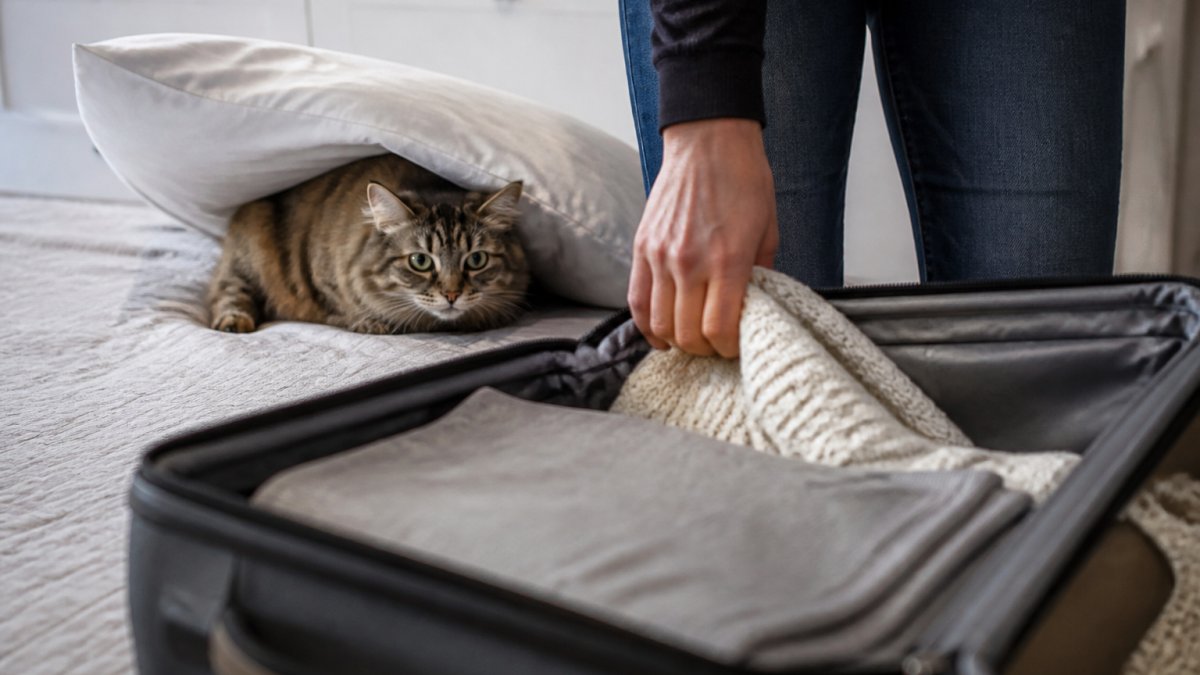
Phase 1: Before the change. Set up one room with the cat's own bedding, litter, food, water, and a pheromone diffuser before anything else moves. Keep the same food, litter brand, and schedule. If you are moving, take a worn t-shirt and rub it on the cat's cheeks, then place it in the carrier a day ahead so the carrier smells like home rather than like a vet visit.
Phase 2: During the change. Confine the cat to the prepared room. Do not let it roam a house full of strangers, open doors, and moving furniture. Visit the room calmly, feed on schedule, and resist the urge to introduce the cat to the new space until the noise and traffic have stopped.
Phase 3: After the change. Introduce new spaces gradually, one room at a time, over several days. Keep the core zone (bed, litter, food) unchanged for at least two weeks. Watch body language closely: a low tail, flattened ears, a crouched posture, or a cat that stops eating means slow down and back up a step.
The Humane Society's guidance on reducing pet stress during moves recommends keeping cats confined to a single prepared room on moving day rather than letting them roam a house full of strangers and open doors.
Age-Specific Stress Management
Most guides give one-size-fits-all advice. Cats at different life stages have different stress triggers, and the protocol should change accordingly.
Kittens (under 1 year). Kittens are in a sensitive socialization window roughly between 2 and 14 weeks. Stress during this period can shape lifelong fear responses. Keep the environment predictable, introduce new people and sounds gradually, and avoid overwhelming a kitten with too many new experiences at once. A kitten that hides during a party is not being antisocial; it is telling you the environment is too much.
Adult cats (1-10 years). Adults are the most adaptable but also the most routine-dependent. A move or a new baby is the biggest disruption. Keep feeding, play, and quiet hours on the same clock, and add an extra play session to burn off the restlessness that comes with a changed environment.
Senior cats (10+ years). Senior cats often lose hearing or eyesight, which makes sudden movements and loud sounds more startling. Keep their core zone unchanged, add night lights so they can navigate at night, and avoid rearranging furniture they navigate by memory. A senior cat that suddenly starts crying at night or pacing may be experiencing cognitive dysfunction, not just stress, and a vet visit is warranted.
Monitoring Stress via Body Language
A shareable, practical checklist is one of the most useful things you can keep on your phone. The subtle signs matter more than the obvious ones.
- Ears: Flattened sideways or pinned back means fear or irritation. Forward and relaxed means curious.
- Tail: A low, tucked tail means anxiety. A stiff, upright tail with a quiver can mean excitement or arousal. A thrashing tail means overstimulation.
- Eyes: Dilated pupils in a well-lit room often signal fear or arousal. Slow blinking is a sign of trust.
- Body: A crouched, hunched posture with weight shifted back means the cat is ready to flee. A relaxed cat has a soft, curved back.
- Whiskers: Pulled back against the face means stress. Forward and fanned means alert and comfortable.
- Vocalization: Excessive meowing, yowling, or chirping outside of normal hunger cues can signal distress, especially in senior cats.
If you see three or more of these signs together, treat it as a signal to reduce stimulation, not to push through.
When You Travel
For owners who travel, the choice between boarding and in-home care matters more than most realize. A boarding facility is a new environment, new smells, and unfamiliar cats. In-home care keeps everything your cat knows exactly where it was. Tracy's Kitty Care sends background-checked, licensed, bonded, and insured sitters into your home so your cat stays in its own territory, with its own routine, while you are away. For cats that hide from strangers, our sitters work at the cat's pace rather than forcing interaction, and they can handle medication and special feeding needs. You can review visit options on our cat sitting service page.
Frequently Asked Questions
What are the common signs of stress in indoor cats?
Signs of stress in cats include hiding more often, excessive grooming, changes in appetite, litter box avoidance, and increased vocalization. You may also notice a tucked tail, flattened ears, or dilated pupils. Some cats become more aggressive or withdraw entirely. Watching your cat's body language daily helps you catch these signals early so you can adjust their environment before stress leads to illness.
Can pheromones help create a stress-free environment for cats?
Yes. Feline pheromone diffusers release synthetic copies of the natural calming signals cats use to mark safe territory. Plugging one into a room where your cat spends most of their time can reduce anxiety-related behaviors like spraying, scratching, and hiding. They work best alongside other changes such as adding vertical space and keeping routines predictable.
How long does it take for a cat to destress after a change?
It varies by cat, but many need one to two weeks to adjust to a new environment or routine. Shy cats may take a month or longer. During this time, keep changes minimal, offer hiding spots, and stick to a consistent feeding schedule. If stress behaviors continue beyond a few weeks, consult your veterinarian to rule out underlying medical issues.
Why is vertical space important for reducing feline stress?
Cats feel safer when they can observe their surroundings from above. Vertical territory like cat trees, shelves, and window perches gives them a sense of control and a place to retreat from other pets or household activity. Providing multiple elevated spots reduces territorial tension, especially in multi-cat homes, and supports natural climbing and scratching behaviors.