 how-to
In-Home Cat Care for Multiple Cats: 2026 Guide
Table of Contents
- How to Set Up Your Home for Multi-Cat Care
- Managing Cat Dynamics: Hierarchy, Aggression, and Safe Zones
- What to Look for in a Cat Sitter for Multiple Cats
- How to Prepare Your Home for a Cat Sitter
- The Cat Sitter Daily Check-In Process for Multi-Cat Households
- Emergency Protocols and Technology for Multi-Cat Care
- Frequently Asked Questions
Last Updated: September 15, 2026
How to Set Up Your Home for Multi-Cat Care
In home cat care for multiple cats succeeds or fails on setup, not affection. Cats are territorial, and a household sharing one food bowl, one litter box, and one windowsill is waiting for conflict.
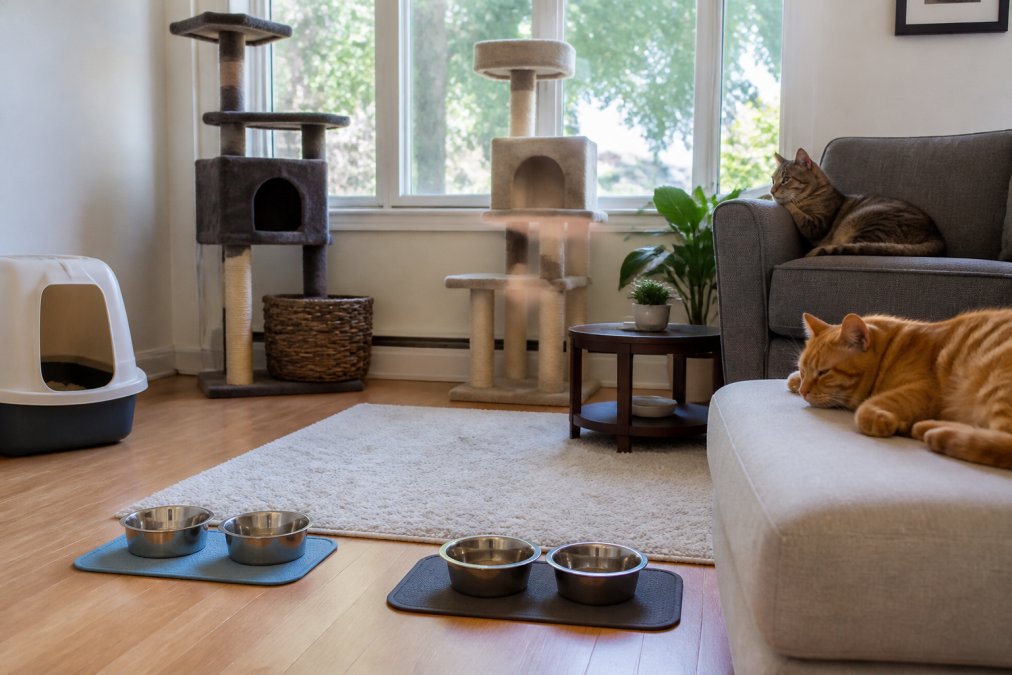
The fix starts with three numbers: one litter box per cat plus one, feeding stations separated by at least three feet, and water sources in at least two locations.
Litter Box Ratios and Placement
The litter box ratio is the single most important rule in a multi-cat home: one box per cat, plus one extra. Three cats means four boxes.
Placement matters as much as count. Lining all the boxes up in the basement laundry room makes them one big litter area, not four separate resources, and a cat who feels cornered will stop using it. Spread boxes across floors and rooms, leave at least two exit routes from each, and scoop daily.
Feeding Stations and Water Distribution
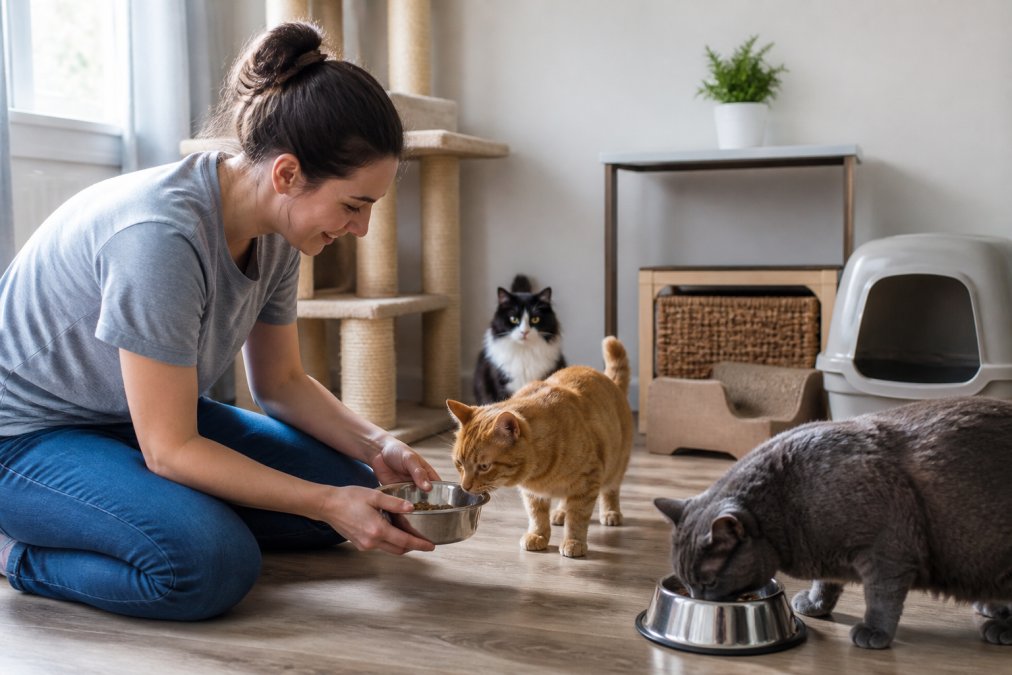
Feeding dynamics in a multi-cat home are rarely about hunger, they're about access. One cat eats fast and guards the bowl; another eats slowly and skips meals. Separate feeding stations by at least three feet, ideally in different rooms with a visual barrier.
Water deserves the same treatment. Cats are poor drinkers, and one who avoids a bowl because a housemate camps nearby is headed for urinary trouble. Offer at least two water sources, keep them away from food and litter, and refresh daily. A pet fountain can help, since moving water triggers a cat's drinking instinct.
Managing Cat Dynamics: Hierarchy, Aggression, and Safe Zones
Social hierarchy in a multi-cat household is real, but it isn't a dictatorship. Cats negotiate resource access constantly, mostly silently: a slow blink, a tail flick, a well-timed stare. Inter-cat aggression usually flares when one cat can't avoid another. The solution is territory management, not punishment.
Your job is to make avoidance easy: safe zones, vertical space, and enough hiding spots that every cat has somewhere no other cat claims.
Reading Cat Body Language and Stress Triggers
Behavioral observation separates a calm multi-cat family from a tense one. Watch for quiet signals first: a cat who stops eating when another enters, crouches low and freezes, or suddenly over-grooms a patch on her flank. Those are stress triggers, not personality quirks.
Overt signs come later, after weeks of building conflict. Hissing, blocking doorways, and guarding the litter box are escalation. Play can also be conflict in disguise: if one cat is always the chaser and the other always the chased, with flattened ears and a puffed tail, that's not play.
Vertical Space, Hiding Spots, and Visual Barriers
Vertical space is the most underused tool in multi-cat homes. Cats resolve conflict in three dimensions, not two. A cat who can perch six feet up no longer needs to fight over the floor. Add cat trees, wall shelves, and cleared bookshelf tops so every cat has a high retreat.
Visual barriers do similar work at ground level: a partially closed door, a tall plant, or a baby gate with a gap lets cats share a room without sharing a sightline. Hiding spots matter too, a covered bed, a cracked closet, or a cardboard box gives a nervous cat a place to decompress. Environmental enrichment isn't decoration; it's conflict resolution.
What to Look for in a Cat Sitter for Multiple Cats
A sitter who's great with one cat can be out of their depth with four. Multi-cat care requires someone who understands resource distribution, can spot a brewing conflict, and won't panic when a shy cat vanishes under the bed. It also requires pricing and a time model that fit a multi-cat household, where most owners get surprised.
The Time Math Nobody Explains Upfront
A 30-minute visit with one cat is a petting session; with four cats it's a logistics operation. Feeding four cats at separated stations, refreshing water sources, scooping four or more boxes, medicating, and doing a headcount and health check doesn't fit in 30 minutes. Most multi-cat specialists say a four-cat household needs 45 to 60 minutes per visit, or two shorter visits per day.
Ask directly: how long does a visit actually take with my number of cats, and does the price change if it runs long? A sitter quoting a flat 30-minute rate for four cats is cutting corners or will burn out by day three.
How Multi-Cat Pricing Usually Works
Pricing models vary, but the common structures are:
- Base rate plus per-cat add-on. A base visit fee covers the first cat or two, with an added charge for each additional cat. This is the most transparent model for large households.
- Flat multi-cat rate. A single higher rate for any household over a set number of cats. Simpler to budget, but you should confirm the visit length.
- Time-based billing. You pay for the time block, and the sitter works through the checklist. Best for households with medication or special needs.
Ask what's included in the base rate and what triggers an extra charge, medication administration, injections, sub-Q fluids, and holiday visits are common add-ons. Get the total in writing before you book.
The Real Cost of Scaling From One Cat to Four
Multi-cat care doesn't scale linearly, but it does scale. The fastest-growing categories:
- Veterinary care. Wellness visits are per cat: four exam fees, four sets of vaccines, four dental cleanings on rotation. Emergency care breaks budgets, one urinary blockage or foreign-body surgery can run into the thousands, and with four cats the odds of at least one event per year rise.
- Pet insurance. Premiums are quoted per cat and rise with age. Some owners insure the younger cats and self-insure seniors, or set aside a savings fund.
- Food and litter. These scale close to linearly, and prescription diets cost more per bag. In a four-box household, buying litter in bulk with auto-delivery beats one-off purchases.
- Preventive care. Flea, tick, and heartworm preventives are dosed per cat monthly. A calendar or shared note keeps track of who got what.
A practical approach: build a per-cat annual budget for routine care, then hold a separate emergency fund sized to cover at least one major event, enough to absorb a single significant surgery without derailing the household.
Insurance, Savings, or Both
Insurance smooths a large unexpected bill into a predictable monthly cost, but premiums rise with age and pre-existing conditions are typically excluded. A savings account gives flexibility and no claim process, but may not be funded fast enough in a crisis.
Cat Sitter Interview Questions That Reveal Real Experience
What to Confirm Before You Book
How to Prepare Your Home for a Cat Sitter
The Cat Sitter Daily Check-In Process for Multi-Cat Households
Here's the order that works:
Emergency Protocols and Technology for Multi-Cat Care
Build a Per-Cat Emergency File Before You Travel
Written Authorization and a Spending Limit
Evacuation Logistics for 3+ Cats
Triage When Multiple Cats Are Affected
Technology That Actually Helps, and Where It Fails
Frequently Asked Questions
How do you manage litter box logistics for multiple cats?
The standard rule is one litter box per cat, plus one extra. For three cats, that means four boxes. Place them in separate, quiet locations so no cat has to guard a box or pass another cat to reach it. Scoop daily and do a full change weekly. In multi-cat care, litter box stress is one of the most common reasons cats eliminate outside the box, so get the ratio right before behavior problems start.
What should I look for in a professional cat sitter for multiple cats?
Look for a sitter who specializes in cats, not general pets. Ask how they handle a shy cat who hides, what their daily check-in process looks like, and whether they can give medication. Confirm they are background-checked, insured, and bonded. For multi-cat care, a sitter should send daily updates with photos and notes on each cat's eating, litter box use, and behavior. That level of detail tells you whether every cat is actually doing well.
How can I prevent stress in multi-cat households when I travel?
Keep routines identical while you are away. Feed at the same times, scoop litter on the same schedule, and leave a worn t-shirt or blanket with your scent in each cat's favorite spot. Set up multiple safe zones with hiding spots and vertical perches so cats can avoid each other if needed. A professional in-home cat sitter who visits at consistent times reduces stress far more than boarding, because the cats stay in their own territory with familiar smells and layouts.
Is it better to board cats or use in-home care?
For most multi-cat households, in-home care wins. Boarding puts cats in an unfamiliar space with strange smells and sounds, which can trigger stress-related illness, especially in shy cats. In-home care keeps them in their own territory with their own resources, routines, and hiding spots. The trade-off is cost and logistics, but a professional sitter who comes to your home eliminates the car ride, the strange environment, and the risk of exposure to other animals.