 how-to
How to Introduce a New Cat: Reduce Stress in 7 Steps
Table of Contents
- What You'll Need Before Bringing Your New Cat Home
- Step 1: Prepare a Safe Room for Your New Cat
- Step 2: Keep Cats Separated During the First Few Days
- Step 3: Use Cat Scent Swapping to Build Familiarity
- Understanding the 3-3-3 Rule for Cats
- Step 4: Start Supervised, Face-to-Face Introductions
- What Not to Do When Introducing Cats
- Troubleshooting Common Setbacks and When to Restart
- Frequently Asked Questions
Last Updated: October 4, 2026
What You'll Need Before Bringing Your New Cat Home
When you introduce a new cat, preparing your home beforehand reduces stress for both cats by creating a safe environment for the newcomer while maintaining your resident cat's sense of security.
Start by gathering these essential supplies:
- A separate room (bedroom, bathroom, or office works well)
- Food and water bowls
- A litter box
- Scratching post or pad
- Hiding spots (cat bed, cardboard box, or cat tree)
- Toys and play wands
- Pheromone diffuser (optional but helpful)
The separate room becomes your new cat's safe space, not punishment, but a refuge. Choose a quiet area away from high traffic and stock it with everything your new cat needs for the first few days.
Make sure your resident cat's resources, their favorite toys, sleeping spots, and litter box, remain accessible and unchanged. This reassures them that their world hasn't been disrupted.
Step 1: Prepare a Safe Room for Your New Cat
Your new cat needs a dedicated space before arriving home, stocked with everything they need within easy reach.
Set up the room a few hours before arrival. Place the litter box in one corner, food and water bowls in another, and create hiding spots (under a bed, in a cardboard box, or on a high shelf) since cats feel vulnerable in open spaces.
Ask the shelter or previous owner for a blanket or toy with your new cat's original scent to help them adjust.
Use a pheromone diffuser, which releases calming compounds that reduce stress behavior during the transition.
Your resident cat should not have access to this room yet. Close the door completely. This separation protects both cats and prevents territorial tension before they're ready for contact.
Step 2: Keep Cats Separated During the First Few Days
Most experts recommend 3-7 days of complete separation, allowing your new cat to acclimate without the stress of encountering a stranger.
During separation, your new cat learns their space and begins to relax, while your resident cat adjusts to the change without direct confrontation.
Spend time in the safe room playing gently and offering treats, but let your new cat approach on their own terms. Hiding for the first day or two is normal and shows they feel safe.
Keep the door closed at all times. Even brief accidental encounters during this phase can trigger fear or aggression that sets back your introduction timeline.
Feed both cats on opposite sides of the closed door. This creates a positive association with each other's presence because they're eating (something pleasurable) while sensing each other nearby.
Step 3: Use Cat Scent Swapping to Build Familiarity
Before face-to-face introductions, help both cats become familiar with each other's scent. Cat scent swapping is one of the most effective ways to reduce stress and build comfort before direct contact.
Rub a soft cloth on your new cat's face and body to pick up their scent, then place it in your resident cat's favorite sleeping spot or on furniture they frequent.
Repeat with your resident cat, placing their scent cloth in the new cat's safe room so both cats smell each other without face-to-face stress.
Swap bedding between the two spaces. Put your new cat's blanket in the main living area and your resident cat's blanket in the safe room. This scent exchange helps normalize each cat's presence.
Continue scent swapping for 3-5 days. You'll notice your cats spending more time near the swapped items and showing less stress behavior as they build familiarity.
Pheromone diffusers in both spaces create a calming environment that reduces tension when face-to-face introductions begin.
Understanding the 3-3-3 Rule for Cats
The 3-3-3 rule breaks down the adjustment timeline into three phases with different expectations.
First 3 days: Your new cat hides and eats minimally while finding safe spaces, completely normal. Your resident cat may pace or vocalize.
First 3 weeks: Your new cat becomes comfortable and explores when the door opens, eating regularly and showing curiosity. Your resident cat begins accepting the new cat's presence, though hissing or swatting may occur.
First 3 months: Both cats settle into a peaceful routine. Some become close companions; others maintain respectful distance. Both outcomes are acceptable.
Understanding this timeline prevents frustration, most cats need weeks or months to truly accept each other.
Step 4: Start Supervised, Face-to-Face Introductions
After 5-7 days of separation and scent swapping, your cats are ready for supervised face-to-face contact.
Open the safe room door and let your new cat explore the main living space for 15-30 minutes while your resident cat is elsewhere, allowing them to gather scents without pressure.
Then reverse the process, letting your resident cat explore the safe room for 15-30 minutes to smell their new housemate.
Repeat this exchange for 2-3 days, then allow face-to-face meetings for just 10-15 minutes initially.
Stay in the room during these initial meetings. Sit quietly and let the cats interact naturally. Have treats ready to reward calm behavior. If tension rises, separate them and try again later.
Watch for stress behavior. Hissing, swatting, stalking, and low body posture indicate the cats need more time apart. Calm behavior, sniffing, and normal movement mean the introduction is progressing well.
Gradually increase the time they spend together. After a few successful short sessions, allow them to share space for longer periods. Most cats reach a comfortable coexistence level within 2-3 weeks.
Reading Cat Body Language During Introductions
Understanding cat body language helps you know when to continue and when to separate them. Cats communicate through their ears, eyes, tail, and body posture, and these signals tell you exactly how they're feeling.
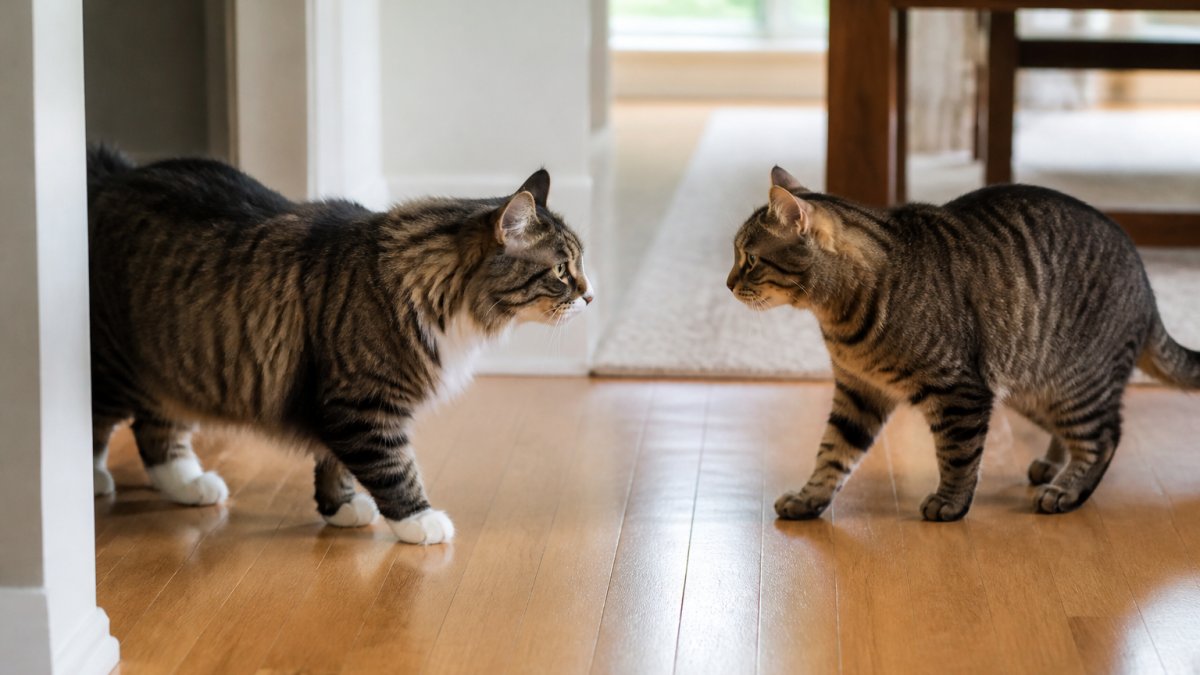
Calm, positive signals:
- Ears forward and relaxed
- Slow blinks (a sign of trust)
- Tail up with a slight hook at the tip
- Loose body posture
- Sniffing each other's faces or rear ends
- Rubbing against each other
Stress and warning signals:
- Ears flattened or turned back
- Wide eyes with dilated pupils
- Tail puffed up or tucked
- Stiff body posture
- Hissing or growling
- Stalking movements
- Swatting or biting
If you see warning signals, separate the cats immediately. Don't wait for a fight to start. Early intervention prevents negative associations that make future introductions harder.
Some cats display mixed signals, they're curious but nervous. This is normal during early meetings. Watch for escalation. If tension increases, separate them. If they remain calm despite some nervous posturing, they're making progress.
What Not to Do When Introducing Cats
Common mistakes during cat introductions can trigger aggression or extend the adjustment timeline significantly. Avoid these pitfalls to keep the process smooth.
Don't rush the timeline. Forcing cats together before they're ready creates fear and aggression that can take months to overcome. Follow the separation and scent-swapping phases even if you're impatient.
Don't punish stress behavior. Your resident cat hissing at a closed door isn't misbehavior, it's normal territorial response. Punishment increases stress and makes them more aggressive toward the new cat.
Don't leave them unsupervised too early. Cats can seriously injure each other during unsupervised meetings. Keep sessions supervised for at least 2-3 weeks, even if they seem to be getting along.
Don't isolate either cat. Your resident cat needs access to their regular spaces and routines. Don't confine them to a different room because your new cat is there. This creates resentment.
Don't use the safe room as punishment. If you use the safe room to isolate your resident cat when they act aggressive, they'll resent it. Instead, calmly separate the cats and give them time apart.
Don't expect instant friendship. Many cats coexist peacefully without being affectionate. This is a successful introduction. Not all cats become best friends, and that's okay.
Troubleshooting Common Setbacks and When to Restart
Even with careful planning, some introductions hit obstacles. Knowing how to recognize and address setbacks prevents minor issues from becoming major problems.
Setback: One cat is extremely stressed and won't eat or use the litter box.
Solution: Return to complete separation immediately. Your new cat may need more time in the safe room before facing the resident cat.
Setback: Your resident cat is blocking the safe room door and preventing your new cat from leaving.
Solution: Install a baby gate or cracked door that allows your new cat to escape if needed. Your resident cat shouldn't be able to corner or trap your new cat.
Setback: The cats had a physical fight during a supervised meeting.
Solution: Separate them completely and restart the introduction timeline. A fight creates fear and negative associations. Wait at least 1-2 weeks before attempting face-to-face contact again.
Setback: After two weeks of meetings, the cats still hiss and swat at each other.
Solution: This is normal for some cats. Extend the introduction timeline to 4-6 weeks. Some cats need months to reach peaceful coexistence.
Many cat owners find that professional support makes a difference. If you're traveling during the introduction phase and can't supervise daily meetings, consider hiring a professional cat sitter.
When to contact a veterinarian:
- Your new cat shows signs of illness (vomiting, diarrhea, not eating)
- Either cat has injuries from fighting
- Stress behavior is extreme (refusal to eat for more than 24 hours, excessive vocalization)
- You're uncertain whether the introduction is progressing normally
A veterinarian can rule out health issues and provide behavior medication if stress is severe.
To introduce a new cat requires patience, but following these steps significantly reduces stress for both cats.
If you're traveling during your cat's adjustment period, professional in-home care makes a real difference. Tracy's Kitty Care's cat sitting service ensures both your new cat and resident cat receive attention, monitoring, and consistent care while you're away. Our sitters understand cat behavior and can watch for signs of stress or conflict. Learn more about our cat sitting service and how we help cats adjust to major changes like introductions.
Frequently Asked Questions
What is the 3-3-3 rule for introducing cats?
The 3-3-3 rule is a timeline that helps cats adjust to a new home: 3 days to decompress in a safe room, 3 weeks to explore and settle into the house, and 3 months to truly feel at home and show their personality. This framework manages expectations and prevents rushing introductions. While individual cats vary, this rule helps owners pace the process and recognize that bonding takes time.
How long should I keep a new cat separated from my resident cat?
Keep cats separated for at least 3 to 7 days before any face-to-face contact. During this time, the new cat stays in a safe room with food, water, litter, and toys while your resident cat adjusts to the new presence through scent and sound. Longer separation (up to 2 weeks) is often better for anxious or older cats. Watch for calm behavior and reduced stress signals before moving to the next step.
How do I know if my cats are ready to meet face-to-face?
Your cats are ready when both show calm behavior: eating normally, using the litter box regularly, and showing curiosity rather than fear. Watch for relaxed body posture, normal play, and interest in the door or scent swaps. If either cat is still hissing, hiding constantly, or showing stress behavior like refusing food, extend the separation period. Patience prevents conflict and sets the foundation for a peaceful relationship.
What should I do if my cats hiss or swat during an introduction?
Hissing and swatting are normal warning signals, not automatic failure. Separate the cats immediately and return to scent swapping for several more days. Resume supervised visits in short sessions (5-10 minutes) with a barrier like a baby gate. If aggression escalates to stalking, prolonged hissing, or injury attempts, restart the entire introduction process from the safe room stage. Some cats need 4-6 weeks or longer.